


SHAPINGfrom Deng Ming-Dao, 365 Tao
Potter at the wheel,
From centering to finished pot,
Form increases as options decrease;
Softness goes to hardness
When a potter begins to throw a pot, she picks up a lump of clay, shapes it into a rough sphere and throws it onto the spinning potter's wheel. It may land off-center, and she must carefully begin to shape it until it is a smooth cylinder. Then she works the clay, stretching and compressing it as it turns. First it is a tower, then it is like a squat mushroom. Only after bringing it up and down several times does she slowly squeeze the revolving clay until its walls rise from the wheel. She cannot go on too long, for the clay will begin to 'tire' and then sag. She gives it the form she imagines, then sets it aside. The next day, the clay will be leather hard, and she can turn it over to shape the foot. Some decoration may be scratched into the surface. Eventually, the bowl will be fired, and then the only options are the colors applied to it; its shape cannot be changed.
This is how we shape all the situations in our lives. We must give them rough shape and then throw them down into the center of our lives. We must stretch and compress, testing the nature of things. As we shape the situation, we must be aware of what form we want things to take. The closer something comes to completion, the harder and more definite it becomes. Our options become fewer until the full impact of our creations is all that there is. Beauty or ugliness, utility or failure, comes from the process of shaping.
Sunday, January 15, 2012
Of Pottery & Life
Thanks to Nancy Watterson for sharing this meditation with me.


Saturday, December 17, 2011
A new take on a Grim(m) tale
I went last night to see Kneehigh Theatre's production of The Wild Bride at the Berkeley Rep. I had been looking forward to this show for months, because I had seen Kneehigh's Brief Encounter (twice!) during its run at ACT a couple of years ago. I loved the imaginative way various media were woven together and especially the way all the actors also danced and sang and played instruments. Music was cleverly and seamlessly integrated into the performance, and the whole thing was delightful. So too with this new show.
The Wild Bride is a retelling of the apparently little-known fairy tale called "The Handless Maiden" (We attended the post-performance chat, and no one else in the audience was familiar with the story.) As a folklorist—and especially as a folklorist who studied with Alan Dundes—I remember the story well ("Das Mädchen ohne Hände"—for some reason, I even remember its German title!).
As with all traditional tales, the story's form varies in different times and different places, but the gist is that a young girl is living with her widowed father. He either decides to marry her, or he is tricked into selling her to the devil. To escape, she cuts off her hands—or has them cut off—and flees into the forest. There she survives until a prince espies her stealing fruit from his trees. He falls in love with her and marries her, despite her missing hands and the fact that she is mute. He has artificial hands fashioned for her, and they live together happily enough. While she is pregnant, he is called away for an extended time. In his absence, she gives birth to a son. The devil intervenes in an exchange of letters between the prince and the queen—who in some versions is jealous and/or suspicious of her daughter-in-law—causes the queen to try to kill the heroine and her child. They escape into the forest, and a deer's eyes and tongue are substituted as proof of the princess's death. In the wild, the heroine cares for her infant son, and in some versions her hands are miraculously restored. When the prince returns to the palace, he is distraught to learn that his family is dead, and he goes mad into the forest. He eventually meets with his wife and son, and the family is reunited.
This story, perhaps to a greater degree than many folktales—or perhaps not (I need to think more about this)—allows for a wide range of interpretation in the telling. It's the how and why of the events that provide the nuance and meaning to the story:
- Why were the girl's hands cut off? Who did it?
- Why does the prince fall in love with her?
- What is the source of the antagonism between the queen and the bride?
- Does the young woman recover her hands? How and why and when does this happen?
I was fascinated to note during the chat that one of the audience members asked about the "edginess" of the father-daughter relationship, which she read as loving but also perhaps inappropriately sensual. The actors responded that there was no specific intent to portray anything other than a loving relationship between the characters. But they also noted that some of their on-stage interaction was based on the actor's rough-and-tumble play with his own daughters—and that perhaps the fact that the actress was not a child but a 27-year-old woman complicated the way their physical interaction came across to the audience. But most interesting to me was the fact that even though incest was not an overt motif in the play, it was still intuited by the audience.
Storyteller Susan Gordon, in an article in Feminist Messages: Coding in Women's Folk Culture, discusses her own telling of the story as a means of reclaiming the heroine's agency in the face of abuse. Many have argued that fairy tales depict women primarily as passive victims of circumstance, and "The Handless Maiden" can offer a particularly extreme version of this image. But Gordon found a way to shape the details of the narrative so as to return a measure of autonomy to the victimized woman and thus to transform her listeners' experience of the story.
Kneehigh takes another tack by emphasizing the character of the devil. He becomes the source of all the heroine's woes: he tricks her father into giving her to him and then forces him to cut off his daughter's hands; he rewrites the prince's letters to his mother, insisting that she slay his wife and child. This leaves the human characters largely blameless ("The devil made me do it!"). In this telling, everyone is victimized by the devil—though the heroine suffers most profoundly by his meddling.
In an inspired move, the heroine is played by three actresses, one for each of the three periods of her life (as a girl in her father's house; in the wild of the forest and as a wife in the castle; in the wild again). The actresses often move/dance in synch, which adds weight and power to this character and offers an impression of female solidarity—particularly when she/they finally beat the devil. It also suggests the changing complexity of an individual life, and the way we carry our past selves with us, even as we evolve over time.
One other wonderful detail (among so many) in this production: the queen is depicted by a life-size painted portrait, with an actress's hands poking through the painting. It creates a wonderful contrast between the handless heroine and the queen, who is nothing but hands. I'm not sure what this means, if anything, but it was a great touch.
Lots more to say about this terrific show (and I need to dig up those articles to refresh my memory on the details), but my key message is this: You should go see it!
Wednesday, November 30, 2011
Painting with Sheep

What shepherds and their clever sheepdogs do when they have too much time on their paws—er, hands. I continue to marvel at the many ways we humans express our creative impulses... (even if some of this creativity takes place post-production! :)
(Thanks to Misha Klein for this one!)
Wednesday, April 13, 2011
What the Right Words Can Do...

What struck me about this was that while the original sign merely described the man and his situation, the new sign made a connection between his experience and the experience of passersby. It created empathy and compassion... and people responded.
Thursday, May 27, 2010
Amen to that!
Heard on NPR:
Too many people who don't know anything about anything say too much about what they don't know...(Context: a comment from a Haitian immigrant woman about the misleading rumors circulating about the temporary legalization being offered to illegal Haitian immigrants in the wake of the earthquake... but applicable to so many things!)
Brontë Sisters action figures
Here's a wonderful (and goofy) girl-power spoof that will resonate with fans of the Brontës and others in their literary sisterhood. Featuring:
Dontcha just wish this were a real product and a real ad?
- super-disguise mustaches!
- boomerang book-throwing action!!
- the Brontësaurus!!!
Dontcha just wish this were a real product and a real ad?
Friday, April 16, 2010
The east arm of the Wintu
I learned from her article "Men Explain Things to Me" (see earlier post) that Rebecca Solnit is the author of numerous books, but I have read only one: A Field Guide to Getting Lost, which I picked up in the DeYoung Museum shop a few years ago, simply because I was intrigued by its title. I enjoyed the book but found the introduction, a rambling essay called "Open Door," to be the most thought-provoking part of it.
Solnit is a promiscuous reader—a quality I admire—and her essays draw on a surprisingly varied array of source material. Readers are invited along on her literary (and literate) excursions through art, philosophy, history, anthropology, ecology and more. One of the passages I underlined in Lost contains an idea I still think about from time to time:

When I looked up a map of the Wintu tribal territory, I was surprised to realize that it is adjacent to the part of the Trinity Alps where my family spent many summer vacations. It's odd to think that I actually know something about what it might mean to be lost in the Wintu neck of the woods—and how easy it is to get disoriented when you have only your rights and lefts to guide you.
IMAGE SOURCE
Solnit is a promiscuous reader—a quality I admire—and her essays draw on a surprisingly varied array of source material. Readers are invited along on her literary (and literate) excursions through art, philosophy, history, anthropology, ecology and more. One of the passages I underlined in Lost contains an idea I still think about from time to time:
Malcolm, apropos of nothing at all, brought up the Wintu in north-central California, who don't use the words left and right to describe their own bodies but use the cardinal directions. I was enraptured by this description of a language and behind it a cultural imagination in which the self only exists in reference to the rest of the world, no you without the mountains, without sun, without sky. As Dorothy Lee wrote, "When the Wintu goes up the river, the hills are to the west, the river to the east; and a mosquito bites him on the west arm. When he returns, the hills are still to the west, but, when he scratches his mosquito bite, he scratches his east arm." In that language, the self is never lost the way so many contemporary people who get lost in the wild are lost, without knowing the directions, without tracking their relationship not just to the trail but to the horizon and the light and the stars, but such a speaker would be lost without a world to connect to, lost in the modern limbos of subways and department stores. In Wintu, it's the world that's stable, yourself that's contingent, that's nothing apart from its surroundings. (p. 17)Solnit goes on to muse further about the ways the nearly extinct Wintu language embeds the speaker into her environment and what happens when that environment changes or disappears, or when people are displaced from it. I'm intrigued by the idea that in the Wintu worldview the self is not "the autonomous entity we think we are when we carry our rights and lefts with us" (pp. 17-18). Instead, even to imagine her own body, a Wintu must understand her relationship to where she is. The task of orienting oneself to a new environment becomes a literal process of learning to identify one's east arm.

When I looked up a map of the Wintu tribal territory, I was surprised to realize that it is adjacent to the part of the Trinity Alps where my family spent many summer vacations. It's odd to think that I actually know something about what it might mean to be lost in the Wintu neck of the woods—and how easy it is to get disoriented when you have only your rights and lefts to guide you.
IMAGE SOURCE
maggie and milly and molly and may and natalie
I heard an interview with Natalie Merchant (formerly of 10,000 Maniacs) on NPR the other day. She talked about her new album, Leave Your Sleep, whose lyrics are based on rhymes that evoke children and childhood. Her selections were gathered from such famous poets as Christina Rossetti, Robert Graves, Robert Louis Stevenson, Ogden Nash, Gerard Manley Hopkins, Edward Lear, e.e. cummings, and many others who are less well known.
I was so taken with what I heard that I bought the album as soon as it was available (hooray for the instant gratification of iTunes!). And then TED emailed me a link to this video, where Merchant performs several songs from the album. I thought it was worth sharing... enjoy!
I was so taken with what I heard that I bought the album as soon as it was available (hooray for the instant gratification of iTunes!). And then TED emailed me a link to this video, where Merchant performs several songs from the album. I thought it was worth sharing... enjoy!
The Overbearing Know-it-all explains things
My friend Misha Klein recently sent me Rebecca Solnit's article called "Men Explain Things to Me," which is very much worth a read. Here's a tidbit:
 One of the delightful things about reading is coming upon (or making) connections between disparate sources. Inspired by Laura Miller's list, I've been reading young adult fiction lately, including a book that everyone but me seems already to have read: Norman Juster's The Phantom Tollbooth. In that book, as heroes Milo, Tock and the Humbug flee the Mountains of Ignorance—with the Princesses Rhyme and Reason in tow—they are pursued by all manner of demons, who are trying to keep them from attaining Wisdom.
One of these demons is someone Rebecca Solnit would recognize all too well:
…the out-and-out confrontational confidence of the totally ignorant is, in my experience, gendered. Men explain things to me, and other women, whether or not they know what they're talking about. Some men.
Every woman knows what I'm talking about. It's the presumption that makes it hard, at times, for any woman in any field; that keeps women from speaking up and from being heard when they dare; that crushes young women into silence by indicating, the way harassment on the street does, that this is not their world. It trains us in self-doubt and self-limitation just as it exercises men's unsupported overconfidence…

One of these demons is someone Rebecca Solnit would recognize all too well:
From off on the right, his heavy bulbous body lurching dangerously on the spindly legs which barely supported him, came the Overbearing Know-it-all, talking continuously. A dismal demon who was mostly mouth, he was ready at a moment's notice to offer misinformation on any subject. And, while he often tumbled heavily, it was never he who was hurt, but, rather, the unfortunate person on whom he fell. (pp. 238-9)IMAGE SOURCE
Sunday, April 4, 2010
Au diable les avocats!
Over the past couple of years I've become a great fan of traditional Québecois music. I love the rich and haunting harmonies, the energetic podorythmie (foot percussion), and the Canadian-accented French lyrics—which are sometimes a challenge to decipher. But more than anything else, this is music that makes me dance!
- Le Vent du Nord is my regular companion and inspiration for many energized walks and spontaneous dancing fits. (Listen to some samples.)
- Thanks to my friend Rudy Busto (merci, RuRu!), I've also recently discovered Les Charbonniers de l'Enfer, an a cappella group singing a traditional repertoire. They're marvelous—as you can hear for yourself. (Apologies to my lawyer friends for the lyrics! :)
Sunday, March 21, 2010
A satisfying ending—and beginning
I loved Laura Miller's book on re-reading Narnia, from which I quoted in my first post. It's both personal and erudite, a memoir of reading and a work of literary criticism. She examines C.S. Lewis' life and personality, his friendship with J.R.R. Tolkien, and the different ways they thought about the fictional worlds they created. Her discussion helped me to appreciate both authors in new ways.
One of Lewis' personal qualities particularly resonated with me: "Like many great readers, Lewis regarded his time alone as his real life" (p. 42). I wouldn't call myself a "great reader," but I well understand the power and draw of that sort of solitary, imaginative experience. Miller writes,
She also helped me see more clearly the delightfully promiscuous way in which Lewis cobbled Narnia together out of elements gleaned from his own favorite books. The fastidious and meticulous Tolkien regarded this practice as shoddy craftsmanship, but it is in fact central to the appeal of the Chronicles. These are books made of books, Miller tells us:
One of Lewis' personal qualities particularly resonated with me: "Like many great readers, Lewis regarded his time alone as his real life" (p. 42). I wouldn't call myself a "great reader," but I well understand the power and draw of that sort of solitary, imaginative experience. Miller writes,
The relationship between book and reader is intimate, at best a kind of love affair... The author who can make a world for a reader—make him believe that the people, places, and events he describes are, if anything, truer than his real, immediate surroundings—that author is someone with a mighty power indeed. Who can forget the first time they experienced this sensation? Who can doubt that every literary encounter they have afterward must somehow be colored by it? (p. 11)By sketching out the framework of Lewis' upbringing and other life experiences, Miller makes the more disturbing aspects of Narnia—its author's suspicion of female sexuality, his elitism, his casual racism and his dislike of things foreign—seem, if not less repugnant, then certainly more intelligible. And through her discussion of Lewis' literary criticism, particularly his work on the medieval romance, Miller suggests a different way of understanding the form of the Narnia books.
She also helped me see more clearly the delightfully promiscuous way in which Lewis cobbled Narnia together out of elements gleaned from his own favorite books. The fastidious and meticulous Tolkien regarded this practice as shoddy craftsmanship, but it is in fact central to the appeal of the Chronicles. These are books made of books, Miller tells us:
A long time ago, I opened a book, and this is what I found inside: a whole new world. It isn't the world I live in, although sometimes it looks a lot like it. Sometimes, though, it feels closest to my world when it doesn't look like it at all. This world is enormous, yet it all fit inside an everyday object. I don't have to keep everything I find there, but what I choose to take with me is more precious than anything I own, and there is always more where that came from. The world I found was inside a book, and then that world turned out to be made of even more books, each of which led to another world. It goes on forever and ever... (p. 303).In addition to the other pleasures of her own book, Miller does her readers a final kindness by providing us a list of both some of the books that inspired Lewis, and other world-opening books that might appeal to fans of Narnia. What could be more delightful than finishing one wonderful book, only to discover a whole new universe of books to explore?
Friday, March 12, 2010
Gratitude with style
I love the thoughtful and whimsical posts in Leah Dieterich's thxthxthx: a thank you note a day. She does such a good job of paying attention to the diverse and unexpected blessings of her everyday experience. Here's just one example:
Love,
Jenny
Dear Future,Thank you, Leah, for reminding me of the twin joys of mindfulness and gratitude! If I'm struggling to think of something that makes my life better, I know I can find inspiration in your blog.
Thank you for only existing in my mind. You're a lot less scary when I realize you're just make believe.
See you when I see you.
Best,
Leah
Love,
Jenny
Saturday, March 6, 2010
Favorites from Billy Collins
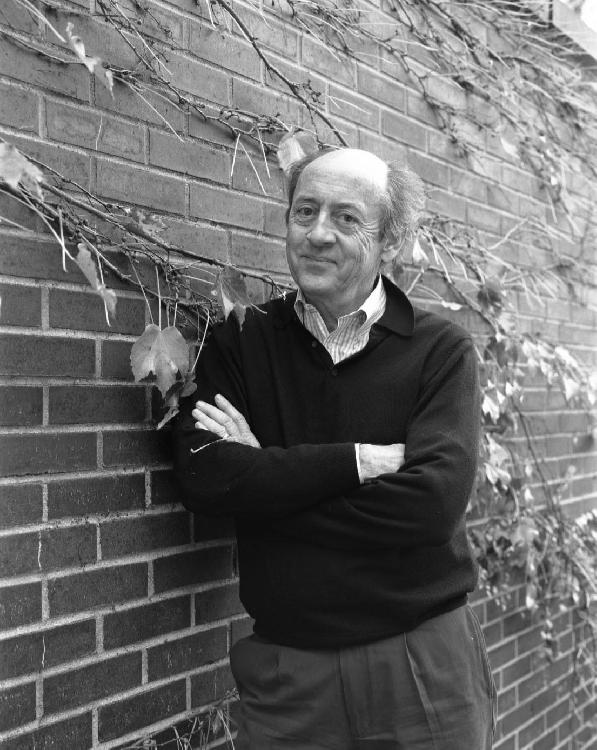
And yet sometimes the right book isn't ready to hand, and I just want to revisit a favorite... In many cases, it turns out, someone else has already posted the poem in question—thereby allowing me to skirt the vexing copyright question and simply point to the relevant page. Here are a few such:
Martha Washington on happiness
My mom had this quote taped up next to her desk for many years—the only such thing she kept there, as far as I recall. It's from a letter from Martha Washington to Mercy Otis Warren:
NOTE ON THE IMAGE: This portrait by Michael J. Deas "was based primarily on a computer generated age-regression image created by an Louisiana State University forensic anthropologist. Contrary to popular belief, Martha Washington was not a dowdy matron, but a witty, astute, and ardent patriot who followed her husband into battle, even encamping with him during the bitter winter at Valley Forge. The portrait is the Nation’s first glimpse at what Martha Washington looked like prior to her marriage to her famous husband."
I have since discovered many other quotes offering similar wisdom, all of which are an important reminder of how important our attitudes are in shaping our experience. While I would never go so far as to claim that we have complete control over our happiness—there being many factors outside our individual control—I do believe that determination and effort together can take us a long way in that direction.I am still determined to be cheerful and happy, in whatever situation I may be; for I have also learned from experience that the greater part of our happiness or misery depends upon our dispositions, and not upon our circumstances.
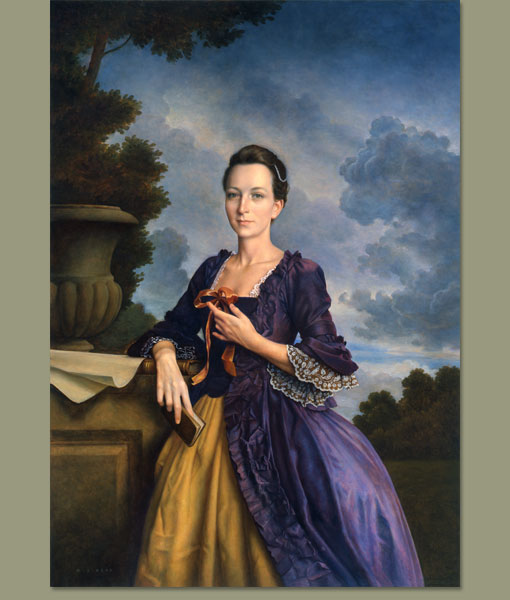
NOTE ON THE IMAGE: This portrait by Michael J. Deas "was based primarily on a computer generated age-regression image created by an Louisiana State University forensic anthropologist. Contrary to popular belief, Martha Washington was not a dowdy matron, but a witty, astute, and ardent patriot who followed her husband into battle, even encamping with him during the bitter winter at Valley Forge. The portrait is the Nation’s first glimpse at what Martha Washington looked like prior to her marriage to her famous husband."
Thursday, March 4, 2010
Speaking with conviction
Ronnie Bruce's typo/videographic setting of a poem by Taylor Mali:
This piece has everything: a thought-provoking message, an energizing performance, witty and wry humor, and clever graphics that enhance the whole. Enjoy!
This piece has everything: a thought-provoking message, an energizing performance, witty and wry humor, and clever graphics that enhance the whole. Enjoy!
Palindrome
Thanks to Misha Klein for this one — a 20-year-old's moving statement of her hopes and possibilities for her generation.
And here's the source of her inspiration:
And here's the source of her inspiration:
Tuesday, March 2, 2010
Creativity and laziness

One of the most wicked destructive forces, psychologically speaking, is unused creative power... If someone has a creative gift and out of laziness, or for some other reason, doesn't use it, the psychic energy turns to pure poison. That's why we often diagnose neuroses and psychotic diseases as not-lived higher possibilities.One of my ongoing goals is spend more time in creative activities. What I have to remember, though, is that creative expression can take many, many different forms. So whether it's cooking or singing or writing emails or dancing or rearranging the furniture (or working on this blog!)... all these activities engage the mind and nurture the spirit.
To crave and to have...

To crave and to have are as like as a thing and its shadow. For when does a berry break upon the tongue as sweetly as when one longs to taste it, and when is the taste refracted into so many hues and savors of ripeness and earth, and when do our senses know any thing so utterly as when we lack it? And here again is a foreshadowing—the world will be made whole. For to wish for a hand on one's hair is all but to feel it. So whatever we may lose, very craving gives it back to us again. Though we dream and hardly know it, longing, like an angel, fosters us, smoothes our hair, and brings us wild strawberries.This was my email signature line for a long time, and I still find it a compelling statement of the power of desire and imagination and dreams.
The reverse may also be true
The TED Talks are one of my favorite sources of new and thought-provoking ideas. Here's a quickie from Derek Sivers in which he gives some thought-provoking examples about the very different ways people in different parts of the world conceptualize the same thing. I particularly love the example of the way Chinese doctors think about health and illness... maybe something for our policy makers to consider!
Here are two other recent TED favorites:
Here are two other recent TED favorites:
- Elizabeth Gilbert talking about a different way to think about creative genius.
- Jacqueline Novogratz discussing what she calls "patient capitalism."
Telling the right story
I'm reading a delightful book by Laura Miller called The Magician's Book: A Skeptic's Adventures in Narnia, about rereading C.S. Lewis' Chronicles of Narnia as an adult. And I came across a couple of passages which struck me and which I wanted to remember:
A new blog seemed the solution, and so here it is. A new experiment. No promise to post regularly or even to deliberately share this with anyone else. Just my personal collectanea—and occasional musings to help me remember why I thought these tidbits worth preserving.
"Adventure," then, is what might otherwise be called a hardship if it were attempted in a different spirit. Turning a difficult task or a perilous journey into an adventure is largely a matter of telling yourself the right story about it... (p.57)
Stories are what make heroes. You can only become a hero by participating in a story, and stories bestow meaning on what might otherwise look like raw suffering and waste.
This, of course, is not always a virtue. You can get people to do a lot of difficult, unpleasant, and dangerous things by convincing them that someday a golden story will be spun out of the straw of their mortal lives. (p.59)But where could I put these words so I could find them again, without having to dig up the book? (a book which by that time would probably have been lent to a friend, who would likely have forgotten to return it!) What I wanted was a space where I could gather and save the interesting ideas or beautifully phrased comments or cool web tidbits I come across from time to time—things that don't necessarily have anything to do with food or cooking, which is the topic of my other blog. In the past, these jewels have just gone into my handwritten journal, but that makes them very difficult to retrieve.
A new blog seemed the solution, and so here it is. A new experiment. No promise to post regularly or even to deliberately share this with anyone else. Just my personal collectanea—and occasional musings to help me remember why I thought these tidbits worth preserving.
Subscribe to:
Posts (Atom)